

-
 0
0
0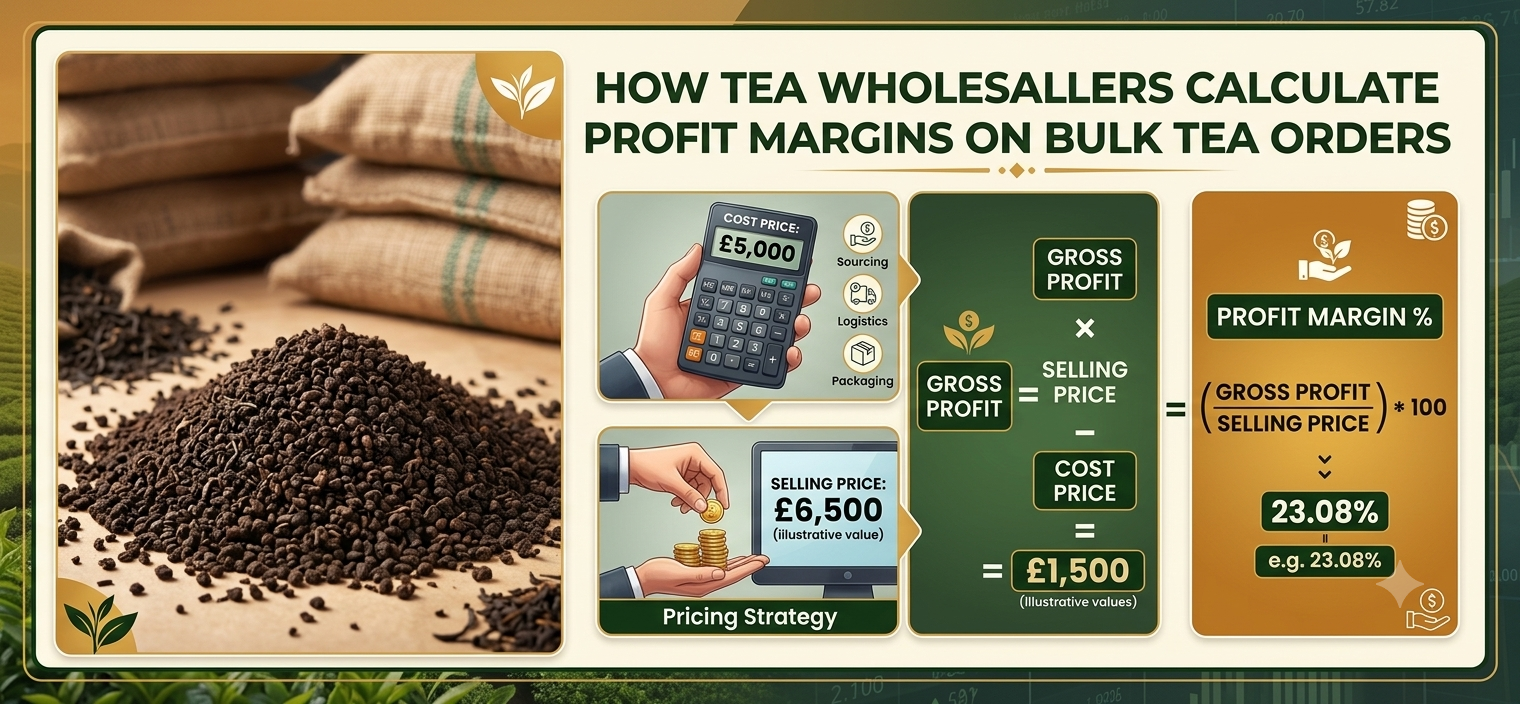
For tea wholesalers, bulk tea orders can generate attractive revenue, but the actual profit depends on much more than the buying and selling price per kilogram. Tea grade, procurement cost, transportation, packaging, storage, wastage, taxes, credit period, order size and customer type can all affect the final margin.
For businesses buying 100 kg, 500 kg, 1,000 kg or more tea, understanding the complete cost structure is essential before quoting a wholesale price.
Prime Gold Tea, the branded tea business of Nutriant Food & Beverages Pvt. Ltd., supplies different tea grades including CTC Tea, Assam Tea, Dooars Tea, BOP, BP, BOPSM, Dust Tea, Black Tea and blended CTC tea for wholesale requirements across India. Its current online catalogue shows several products with 100 kg minimum orders, making bulk-order costing particularly relevant for wholesalers and distributors.
A tea wholesaler purchases tea in larger quantities and resells it to retailers, distributors, tea shops, hotels, restaurants, institutional buyers, packaging companies or other businesses.
The basic calculation is:
Gross Profit = Selling Revenue − Total Product Cost
And:
Gross Profit Margin (%) = Gross Profit ÷ Selling Revenue × 100
For example, if a wholesaler purchases tea at ₹180/kg and sells it at ₹220/kg:
Gross Profit = ₹220 − ₹180 = ₹40/kg
Gross Profit Margin = ₹40 ÷ ₹220 × 100 = 18.18%
However, ₹40/kg is not necessarily the wholesaler's final profit because transportation, packaging, loading, storage, finance costs and other expenses still have to be deducted.
A professional wholesaler normally looks at the landed cost rather than simply comparing the supplier's quoted tea price with the customer's selling price.
Landed Cost per kg = Tea Purchase Cost + Freight + Loading/Unloading + Packaging + Other Direct Costs
Then:
Net Profit per kg = Selling Price − Landed Cost − Allocated Operating Expenses
This provides a much more realistic picture of profitability.
The first and most important component is the price paid to the tea supplier.
The price varies according to:
Tea type
Tea grade
Origin
Leaf/granule size
Liquor strength
Aroma
Season
Quality consistency
Blending requirements
Order quantity
Market conditions
Prime Gold Tea's current catalogue, for example, lists different wholesale products at different prices. Its displayed products include Grade BP CTC Tea at ₹150/kg, Dooars CTC Tea Grade BOP at ₹145/kg, BOPSM Black CTC Dooars Tea at ₹192/kg and Blended CTC Loose Tea at ₹195/kg, with the listed products generally carrying 100 kg minimum orders. These are website-listed prices and should not be treated as a universal market rate.
This difference in procurement price directly affects the wholesaler's potential margin.
Bulk purchasing can reduce the average cost per kilogram.
For example:
| Order Quantity | Example Purchase Rate | Tea Cost |
|---|---|---|
| 100 kg | ₹195/kg | ₹19,500 |
| 500 kg | ₹190/kg | ₹95,000 |
| 1,000 kg | ₹185/kg | ₹1,85,000 |
| 5,000 kg | ₹180/kg | ₹9,00,000 |
These are illustrative calculations, not quoted Prime Gold Tea rates.
A larger order may allow a buyer to negotiate better rates, but the buyer must also consider storage capacity, working capital and the speed at which the stock can be sold.
The supplier's quoted price may not represent the wholesaler's final cost.
Transportation can include:
Factory-to-warehouse freight
Loading charges
Unloading charges
Local transportation
Transport documentation
Delivery charges
Insurance, where applicable
For example:
Tea purchase price = ₹180/kg
Freight allocation = ₹8/kg
Then:
Landed tea cost = ₹188/kg
If the wholesaler sells at ₹220/kg, the apparent ₹40/kg difference has already reduced to ₹32/kg before other expenses.
Packaging becomes particularly important when a wholesaler does not simply resell tea in bulk sacks.
A wholesaler may sell:
Loose tea
5 kg packs
10 kg packs
25 kg sacks
50 kg sacks
100 kg bulk lots
Private-label retail packs
Packaging costs may include:
Bags
Inner liners
Labels
Printing
Sealing
Cartons
Labour
Packing machinery
Retail packaging
For example, if packaging costs ₹6/kg, a tea purchase costing ₹180/kg effectively becomes ₹186/kg before freight and other expenses.
Prime Gold Tea's website identifies bulk supply across different tea categories and also highlights wholesale-oriented products and minimum-order quantities. (Prime Gold Tea)
Not every kilogram of tea can be sold at the same price.
Different grades have different commercial applications.
For example, wholesalers may deal in:
BOP CTC Tea
BP CTC Tea
BOPSM CTC Tea
Dust CTC Tea
Blended CTC Tea
Assam Tea
Dooars Tea
Darjeeling Tea
Green Tea
Black Tea
Prime Gold Tea's catalogue currently includes multiple CTC, Assam, Dooars and other tea categories, with separate prices and minimum-order quantities. (Prime Gold Tea)
A wholesaler therefore calculates margin grade by grade, rather than applying one percentage to the entire inventory.
Consider a hypothetical order of 100 kg of CTC tea.
Suppose:
| Cost Component | Amount |
|---|---|
| Tea purchase price | ₹190/kg |
| Quantity | 100 kg |
| Tea purchase cost | ₹19,000 |
| Freight | ₹1,000 |
| Loading/unloading | ₹300 |
| Packaging | ₹500 |
| Other direct expenses | ₹200 |
| Total Cost | ₹21,000 |
Therefore:
Effective cost per kg = ₹21,000 ÷ 100 = ₹210/kg
Suppose the wholesaler sells the tea at:
₹245/kg
Revenue:
100 × ₹245 = ₹24,500
Gross profit:
₹24,500 − ₹21,000 = ₹3,500
Gross margin:
₹3,500 ÷ ₹24,500 × 100 = 14.29%
This is more realistic than simply calculating:
₹245 − ₹190 = ₹55/kg.
The ₹55/kg difference is a price spread, not the final profit.
Now consider a larger order.
Assume:
Quantity = 1,000 kg
Purchase price = ₹185/kg
Freight = ₹6/kg
Packaging = ₹4/kg
Handling and other direct costs = ₹3/kg
₹185 + ₹6 + ₹4 + ₹3 = ₹198/kg
Total cost:
1,000 × ₹198 = ₹1,98,000
Suppose selling price:
₹225/kg
Revenue:
1,000 × ₹225 = ₹2,25,000
Gross profit:
₹2,25,000 − ₹1,98,000 = ₹27,000
Gross margin:
₹27,000 ÷ ₹2,25,000 × 100 = 12%
Again, this is an illustrative example, not a guaranteed tea-business margin.
Many wholesalers confuse markup with profit margin.
Suppose:
Cost = ₹200/kg
Selling price = ₹240/kg
The markup on cost is:
₹40 ÷ ₹200 × 100 = 20%
But the gross profit margin is:
₹40 ÷ ₹240 × 100 = 16.67%
Therefore, when comparing tea wholesale profitability, always clarify whether someone is talking about markup on cost or margin on selling price.
A proper tea wholesale calculation should consider the following:
| Cost | Include in Calculation? |
|---|---|
| Tea purchase price | Yes |
| Freight | Yes |
| Loading/unloading | Yes |
| Packaging | Yes |
| Warehouse cost | Yes |
| Labour | Yes |
| Wastage/shrinkage | Yes |
| Interest/working-capital cost | Yes |
| Sales commission | Yes |
| Discounts | Yes |
| Delivery to customer | Yes |
| GST/taxes | Depends on accounting treatment |
| Marketing | Allocate where relevant |
| Payment collection cost | Where applicable |
This gives the wholesaler a better understanding of actual contribution and net profitability.
Tea wholesale is a volume-driven business.
A buyer purchasing 1,000 kg at ₹200/kg has ₹2 lakh tied up in inventory before considering additional expenses.
If the customer pays after 30 or 60 days, the wholesaler may have to finance the inventory and receivable.
Therefore:
Profit ≠ Cash Flow
A transaction can show a positive accounting margin while still putting pressure on working capital.
Wholesalers should therefore track:
Inventory value
Customer credit
Supplier payment terms
Stock turnover
Outstanding receivables
Interest cost
Reorder cycle
Different customers may have different price expectations and order sizes.
Retailers generally purchase smaller quantities than large distributors but may accept different grades and packaging formats.
They often focus on:
Strong liquor
Consistent taste
Colour
Brewing performance
Regular supply
Competitive per-kg pricing
Distributors generally work with larger volumes and therefore negotiate aggressively on price.
These customers may prioritize consistency, supply reliability and specifications alongside price.
Private-label buyers may require:
Custom blends
Packaging
Printed pouches
Brand labels
Specific pack sizes
Consistent batch quality
This can create additional revenue opportunities but also adds packaging and operational costs.
Prime Gold Tea has previously described bulk supply for retailers, distributors, tea businesses, packaging units and private-label buyers, with custom blending and packaging requirements among the services discussed on its website. (Prime Gold Tea)
Avoid purchasing large quantities simply because the supplier offers a lower price.
A cheaper kilogram can become expensive if the stock remains unsold for a long period.
Don't compare suppliers only on the quoted tea price.
Compare:
Purchase Price + Freight + Packaging + Other Costs
A 100 kg buyer and a 2,000 kg buyer may have different negotiating positions.
Cheap tea that produces inconsistent liquor can result in customer complaints and repeat-order losses.
For B2B buyers, bulk packaging may be more economical than individual retail packaging.
Profitability depends not only on margin per kilogram but also on how quickly inventory converts into sales.
Maintain individual calculations for:
BP
BOP
BOPSM
Dust
Blended CTC
Assam
Dooars
Darjeeling
Green Tea
Other grades
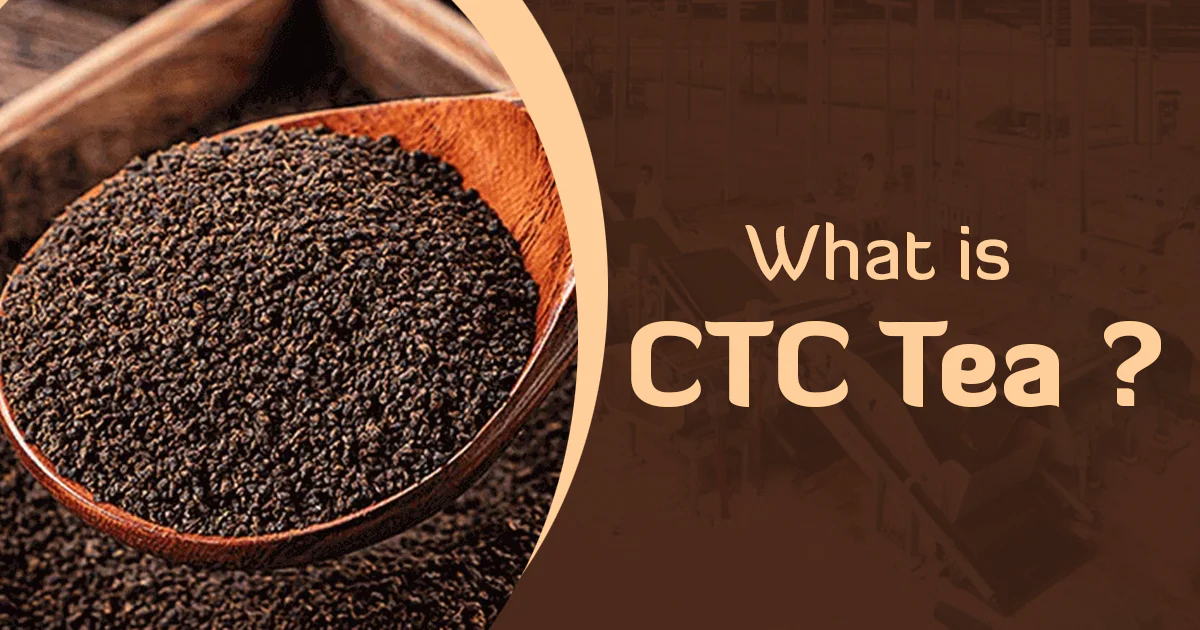
CTC tea is processed using the Crush, Tear, Curl method and is widely used for strong, quick-brewing tea preparations.
For commercial buyers, important factors include:
Strong liquor
Colour
Brewing strength
Granule consistency
Aroma
Price per kilogram
Batch consistency
Supply availability
Prime Gold Tea currently lists multiple CTC options, including BP, BOP, BOPSM, Dust and blended CTC products, alongside Assam and Dooars tea categories. (Prime Gold Tea)
Suppose the landed cost is ₹200/kg.
| Selling Price | Profit/kg | Gross Margin |
|---|---|---|
| ₹210 | ₹10 | 4.76% |
| ₹220 | ₹20 | 9.09% |
| ₹230 | ₹30 | 13.04% |
| ₹240 | ₹40 | 16.67% |
| ₹250 | ₹50 | 20.00% |
| ₹260 | ₹60 | 23.08% |
This illustrates an important point: small changes in selling price can materially change the wholesaler's gross margin.
However, the appropriate selling price depends on market conditions, tea quality, competition, customer requirements and the wholesaler's actual cost structure.
Suppose:
Tea purchase = ₹180/kg
Freight = ₹7/kg
Packaging = ₹5/kg
Handling = ₹3/kg
Other direct expenses = ₹2/kg
Then:
Total landed cost = ₹197/kg
If the wholesaler also has an allocated operating expense of ₹8/kg:
Break-even cost = ₹205/kg
The tea must therefore be sold above ₹205/kg to generate an operating contribution, assuming the allocation is accurate.
For wholesalers, distributors, retailers, tea shops and commercial buyers, choosing a supplier that can provide multiple grades and consistent bulk supply can simplify procurement.
Prime Gold Tea, the branded business of Nutriant Food & Beverages Pvt. Ltd., lists wholesale tea categories including Loose CTC Tea, Assam CTC Tea, Dooars Tea and Assam Tea. Its online catalogue currently shows several bulk products with minimum quantities such as 100 kg, while some Assam products have 25 kg minimum orders. (Prime Gold Tea)
The company states that its tea is sourced from tea estates and that batches undergo a five-step testing procedure before reaching customers. (Prime Gold Tea)
For a buyer comparing bulk tea suppliers, the practical approach is to request the current grade-specific price, MOQ, packing format, freight cost and applicable commercial terms before calculating the final margin.
Explore Prime Gold Tea's Bulk Tea Range
Before buying 100 kg or more, wholesalers should ask:
What is the current price per kg?
What is the minimum order quantity?
Which tea grade is being supplied?
Is the quoted price inclusive or exclusive of applicable taxes?
What is the packing format?
What is the freight cost to my location?
Can I request a sample before ordering?
Is the same grade available for repeat orders?
What are the payment terms?
What is the expected dispatch time?
Can the supplier provide customised blending?
Is private-label packaging available?
What happens if the delivered batch does not match the agreed specification?
There is no single fixed tea wholesale profit margin. It depends on purchase price, tea grade, selling price, freight, packaging, wastage, finance costs, customer type and operating expenses.
Use:
Gross Profit = Total Sales − Total Direct Cost
For margin:
Gross Margin (%) = Gross Profit ÷ Sales × 100
Tea wholesale profitability depends on procurement costs, sales volume, stock turnover, customer pricing and operating expenses. High sales volume alone does not guarantee high profitability.
Markup is calculated against cost, while margin is calculated against selling revenue. A ₹40 difference on a ₹200 cost represents 20% markup but only 16.67% gross margin when sold for ₹240.
It can, depending on the supplier's volume pricing, order quantity, freight arrangement and commercial terms. Buyers should compare the complete landed cost rather than purchase price alone.
Bulk buyers can source grades such as BP, BOP, BOPSM, Dust, blended CTC, Assam, Dooars and other tea varieties, depending on supplier availability and requirements. Prime Gold Tea currently lists several of these categories. (Prime Gold Tea)
MOQ varies by product and supplier. Prime Gold Tea's current online catalogue lists several CTC products at 100 kg minimum order quantities, while some Assam tea products are listed at 25 kg. (Prime Gold Tea)
Yes. For a realistic calculation, freight and other direct costs should be included in the landed cost.
Wholesalers can focus on competitive procurement, accurate costing, efficient logistics, suitable packaging, stock turnover, repeat customers and reducing avoidable operating costs.
Comparing suppliers helps buyers evaluate price, tea grade, quality consistency, MOQ, packaging, freight, payment terms and supply reliability instead of choosing solely on the lowest quoted price.
Calculating profit on a bulk tea order is not simply a matter of subtracting the supplier's price from the customer's selling price.
A proper calculation should follow:
Tea Purchase Price → Freight → Packaging → Handling → Other Direct Costs → Landed Cost → Selling Price → Gross Profit → Operating Expenses → Net Profit
For wholesalers buying 100 kg, 500 kg, 1,000 kg or larger quantities, even a difference of a few rupees per kilogram can significantly affect the total order economics.
For current bulk tea requirements, buyers can review the Prime Gold Tea range and request product-specific commercial pricing based on grade, quantity and delivery location. (Prime Gold Tea)